4 days in Bohol: beyond the Chocolate Hills
The short answer
3 days in Bohol is enough for a first visit. 4 days is when it gets interesting.
With an extra day, you stop ticking off the highlights and start actually experiencing the island. You get to Balicasag early before the boats crowd in. You have time for a slow morning in Panglao without feeling like you’re already behind schedule. You might even make it to Anda – one of the most beautiful and undervisited parts of Bohol that most travelers never see.
This itinerary is built for travelers who have 4 days and want to use them well. Not rushed, not padded – just the right amount of Bohol.
Already visited Bohol before and wondering whether to come back? Read our comparison of Cebu vs Bohol to see how the two islands compare for a return visit.
Why 4 days works better than 3
Most first-time visitors spend 3 days in Bohol and leave satisfied. But satisfied is not the same as unhurried.
With 3 days, you cover the classics – Chocolate Hills, tarsiers, Loboc River, Balicasag island hopping – but you do it at pace. One experience follows another before you’ve had time to settle into any of them.
With 4 days, everything breathes a little more. You get the same highlights but with room to actually be present in them. And you unlock experiences that simply don’t fit into a 3-day schedule – a sunrise at the Chocolate Hills viewpoint before the crowds, a second morning of snorkeling at Balicasag, or a quiet afternoon in Anda that feels like discovering a completely different island.
Bohol is larger than most travelers expect. Getting around takes time. 4 days is the format that respects that.
Getting to Bohol from Cebu
The most common way to reach Bohol is by ferry from Cebu City. Fast craft options take around 90 minutes from Pier 1 to Tagbilaran Port. Regular ferries take around 2 hours and are cheaper.
Several operators run this route daily. Booking in advance is recommended during peak season – December to May – as seats on fast craft fill up quickly.
From Tagbilaran, the main bases for most travelers are Panglao Island (for beaches and island hopping) and Tagbilaran City (for logistics and the ferry connection). Most of the itinerary below works from either base.
Planning a wider Philippines trip? Read our 7-day Philippines itinerary to see how Bohol fits into a Cebu + Bohol route.
Day 1: Chocolate Hills, tarsiers and Loboc River
The classic Bohol countryside day
Day 1 covers the inland highlights that define Bohol for most travelers. These are the experiences people come here for, and they deserve a full, unhurried day.
Morning: Chocolate Hills
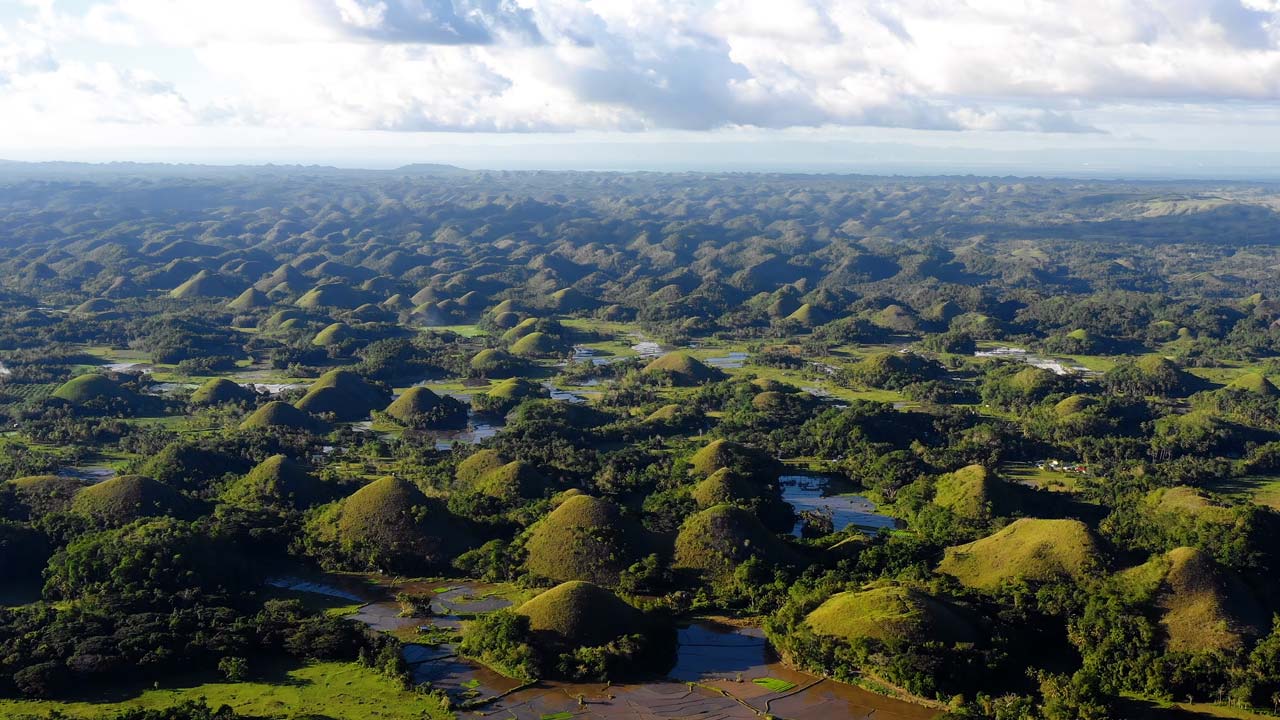
Start early. The Chocolate Hills viewpoint at Carmen is best before 9am – the light is softer, the air is cooler, and you have the panorama largely to yourself before the day-trip groups from Cebu arrive.
The hills are more striking in person than in photographs. Over 1,200 perfectly cone-shaped mounds stretch across the landscape as far as you can see. In the dry season they turn brown, giving them their name. In the wet season they’re green. Either way, they’re unlike anything else in Southeast Asia.
Give yourself at least an hour here. Sit with it.
Mid-morning: Philippine tarsier sanctuary
From Carmen, head toward Corella for the Philippine Tarsier Sanctuary – one of the most responsible wildlife experiences in the Philippines.
Tarsiers are among the world’s smallest primates – tiny, enormous-eyed and completely extraordinary. The sanctuary operates in a semi-wild environment where the tarsiers live freely in the trees rather than in cages. Guides are mandatory, group sizes are controlled, and photography rules exist to protect the animals from stress.
This is how wildlife encounters should work.
Afternoon: Loboc River cruise
End the first day on the river. The Loboc River cruise is a 1-hour boat journey through dense jungle, typically with lunch served on board. It’s relaxed, beautiful and a good way to decompress after a morning of movement.
Some travelers find it touristy – and it is, a little. But the river itself is genuinely lovely, and the pace is exactly right for a late afternoon.
Evening: explore the restaurants and waterfront around Alona Beach on Panglao. This is your best option for food variety and a gentle first night on the island.
Day 2: Balicasag Island and island hopping
Bohol’s marine highlight
Day 2 is the water day – and it’s the one most people remember longest.
Depart early
The best island hopping boats leave by 6:30 – 7:00am. This is not negotiable if you want Balicasag before the crowds. By 9am, the snorkeling areas are busy. By 10am, they’re crowded. The difference between early and late is significant.
Balicasag Island
Balicasag is a small protected marine sanctuary about 45 minutes offshore from Panglao by bangka boat. The waters here are exceptional – clear, rich and protected from commercial fishing. The marine life is extraordinary.
Sea turtles are the headline attraction, and sightings are close to guaranteed in the turtle sanctuary area. You’ll likely find yourself swimming alongside two or three at a time, completely unhurried, moving through the water as if you’re not there.
Beyond the turtles, the coral walls around Balicasag drop sharply into deep water. Reef sharks, jacks, moray eels and parrotfish are common. For divers, this is considered one of the best sites in the Visayas.
Virgin Island sandbar
After Balicasag, most island hopping routes continue to Virgin Island – a white sandbar surrounded by shallow turquoise water that appears at low tide. It’s a good place to swim, walk and take in the open sea before heading back.
Afternoon: rest, swim from Alona Beach, or take a slow walk along the Panglao shoreline. After an early morning on the water, a quiet afternoon is the right call.
For a full picture of what Bohol has to offer, read our 3-day Bohol itinerary which covers the core highlights in detail.
Day 3: Pamilacan Island and dolphin watching
The day that surprises people
Pamilacan Island is one of Bohol’s best-kept secrets – a small island southeast of Panglao, known for dolphin and whale watching in the early morning and excellent snorkeling.
This is the day that separates a 4-day Bohol itinerary from a 3-day one. Most travelers with 3 days never make it here.
Early morning: dolphin watching
Spinner dolphins are regularly spotted in the waters around Pamilacan, often in large pods. The tours depart before sunrise – typically around 5:00 – 5:30am – and return by mid-morning.
It’s an early start, but watching a pod of dolphins move through calm water in the first light of the day is one of those experiences that’s hard to put into words afterward.
Mid-morning: Pamilacan snorkeling
After the dolphin watching, the boats usually continue to snorkeling spots around the island. The coral here is healthy and less visited than Balicasag – a different kind of underwater experience, quieter and more intimate.
Afternoon: Baclayon Church and Blood Compact Shrine
Spend the afternoon exploring two of Bohol’s most significant cultural landmarks.
Baclayon Church is one of the oldest stone churches in the Philippines – built in the 16th century by Spanish missionaries using coral stones. The adjacent museum contains some of the most interesting religious artifacts in the Visayas.
The Blood Compact Shrine, a short drive away, marks the site of the first recorded friendship treaty between a Filipino leader and a Spanish explorer – a piece of history that shaped the entire colonial period of the Philippines.
Neither site requires more than an hour, but both are worth a stop on the way back from the coast.
Evening: Alona Beach for a last dinner with a sea view.
Day 4: Anda – the side of Bohol most travelers miss
The quiet ending
If Days 1, 2 and 3 show you the popular side of Bohol, Day 4 shows you the real one.
Anda is a municipality in the eastern part of Bohol, about 2 hours from Tagbilaran by road. Most travelers never go there. The beaches are white, the water is clear and calm, and the atmosphere is as far from the Panglao tourist strip as you can get while still being on the same island.
Morning: drive to Anda
The road to Anda passes through rural Bohol – rice fields, coconut groves, small towns and slow traffic. The drive itself is part of the experience. Give yourself the full morning.
Midday: Anda beaches
The beaches around Anda are among the most naturally beautiful in Bohol. Quinale Beach is the most well-known – a long stretch of white sand with clear shallow water and almost no infrastructure. Just sand, palm trees and sea.
There are no crowds here. There is no island hopping package waiting for you. Just a beach on a quiet corner of a beautiful island.
Swim, walk, read, sleep in the shade. This is what slow travel in the Philippines actually feels like.
Afternoon: Candijay and Cadapdapan Rice Terraces
If you have energy after the beach, the Cadapdapan Rice Terraces are a short detour on the way back toward Tagbilaran – a surprisingly dramatic landscape of terraced rice paddies carved into the hillsides that most visitors to Bohol never see.
They’re not as famous as the Banaue Rice Terraces in the north, but they’re genuinely beautiful and completely uncrowded.
Evening: return to Tagbilaran for your onward journey
Day 4 usually ends with a late afternoon or evening ferry back to Cebu, or a transfer to the airport for a domestic connection.
Why this 4-day route works
Every day has a different energy:
- Day 1 – countryside, culture and iconic landscapes
- Day 2 – marine life and island hopping at their best
- Day 3 – the surprise day that most 3-day visitors miss
- Day 4 – slow travel and the quieter side of Bohol
Nothing repeats. Nothing feels rushed. And by the time you leave, you’ve seen a version of Bohol that most visitors don’t.
Where to stay in Bohol
Panglao Island is the most popular base – well connected to Balicasag and Virgin Island, good restaurant options, and close to Alona Beach. Best for travelers who want easy access to marine activities.
Tagbilaran City is more practical and less touristy – closer to the ferry port and better for early morning departures. Best for travelers who prefer a quieter base.
For Day 4 in Anda, some travelers choose to stay overnight in the area rather than making it a day trip. If you have the flexibility, it’s worth considering.
Best time to visit Bohol
November to May is the dry season and generally the best time for Bohol. Seas are calmer, visibility for snorkeling and diving is better, and weather is more predictable.
The dolphin watching around Pamilacan is best in the early dry season – November to February – when large pods are most commonly spotted.
June to October brings more rain and rougher seas, which can affect island hopping and ferry connections. That said, Bohol can be visited year-round, and the wet season brings fewer crowds and noticeably lower prices.
Can you combine Bohol with other destinations?
Yes – and most visitors do.
Cebu + Bohol is the most popular combination. Cebu and Bohol are connected by a 2-hour ferry from Pier 1 in Cebu City to Tagbilaran Port. Together they make one of the best first-trip Philippines routes available.
Bohol + Coron is a more ambitious combination, requiring a domestic flight, but it covers two completely different landscapes – the countryside and marine life of Bohol followed by the dramatic lagoon scenery of Coron.
Read our 10-day Philippines itinerary to see how Bohol fits into a longer multi-island route.
Practical tips for 4 days in Bohol
- Book the Pamilacan dolphin watching tour in advance – boats are limited and spots go quickly during peak season
- Hire a private driver for Day 1 and Day 4 – Bohol is large and public transport between sights is slow and inconvenient
- Bring cash – many smaller restaurants, guesthouses and boat operators in Anda and around Panglao don’t accept cards
- Go early for everything on the water – Balicasag and Pamilacan are best before 8am, consistently
- Pack reef-safe sunscreen – standard sunscreen damages the coral and is actively discouraged at marine sanctuaries
- Confirm ferry times in advance – schedules change seasonally and booking ahead is essential during peak season
Final thoughts
Four days in Bohol gives you enough time to experience the island the way it deserves to be experienced – not rushed, not reduced to a checklist, but actually absorbed.
The Chocolate Hills at sunrise. The turtles at Balicasag moving through clear water. A quiet beach in Anda where there’s nobody else around. These are the kinds of moments that bring people back to the Philippines.
If you’re looking to explore Bohol as part of a private, well-coordinated trip – with trusted local logistics and no shared groups – take a look at our Bohol tour packages or start with a custom island itinerary built around your dates and travel style.
FAQ
Is 4 days enough in Bohol?
Yes – 4 days is an excellent amount of time for Bohol. It gives you the classic highlights (Chocolate Hills, tarsiers, Balicasag island hopping) plus enough space to discover the quieter side of the island, including Pamilacan Island and Anda.
What is the best 4-day Bohol itinerary?
The most balanced 4-day route combines the Bohol countryside on Day 1, Balicasag island hopping on Day 2, Pamilacan dolphin watching and cultural landmarks on Day 3, and the quieter beaches and rice terraces of Anda on Day 4.
What is the difference between 3 days and 4 days in Bohol?
With 3 days, you cover the essential highlights. With 4 days, the pace slows down and you access experiences that simply don’t fit into a shorter trip – Pamilacan Island, Anda’s beaches and the Cadapdapan Rice Terraces being the main additions.
Is Balicasag Island worth it?
Without question. Balicasag is one of the best snorkeling experiences in the Philippines – close-up sea turtle encounters, healthy coral and exceptional visibility in a protected marine sanctuary. It’s the marine highlight of any Bohol trip.
How do you get from Cebu to Bohol?
By fast ferry from Pier 1 in Cebu City to Tagbilaran Port, Bohol. Journey time is around 90 minutes on fast craft. Multiple sailings run daily. Booking in advance is recommended during peak season.
What is the best base in Bohol?
Panglao Island is the most popular base for its beach access and proximity to Balicasag Island departure points. Tagbilaran City is more practical for logistics and ferry connections. For Day 4 in Anda, staying overnight in the area is worth considering if your schedule allows.
Is Bohol better than Cebu?
They offer completely different experiences. Cebu is more dynamic – marine life, waterfalls, adventure and city culture. Bohol is softer – countryside landscapes, wildlife, relaxed beaches and island hopping. Most travelers who have time visit both. Read our full Cebu vs Bohol comparison for a detailed breakdown.

 Secure payments • Trusted providers